Union Budget 2026: The Strategic “Operating System” for Indian Tech Startups
Introduction The Union Budget 2026-27 has officially signaled the end of the “quick-fix” subsidy era. Finance Minister Nirmala Sitharaman has instead unveiled a structural “Operating System” for the Indian tech ecosystem—focusing on long-term infrastructure, tax predictability, and a massive bet on the Orange Economy. For the Indian tech ecosystem, this isn’t just another fiscal plan; […]
Introduction

The Union Budget 2026-27 has officially signaled the end of the “quick-fix” subsidy era.
Finance Minister Nirmala Sitharaman has instead unveiled a structural “Operating System” for the Indian tech ecosystem—focusing on long-term infrastructure, tax predictability, and a massive bet on the Orange Economy.
For the Indian tech ecosystem, this isn’t just another fiscal plan; it’s a strategic blueprint for the next decade of innovation.
As India marches toward Viksit Bharat 2047, the 2026 budget provides the “predictable rails” necessary for startups to transition from disruptors to national infrastructure.
In this guide, we break down the key takeaways every founder, investor, and tech professional must understand.
Startup India Fund of Funds (FFS) 2.0 Boost

The government has approved Startup India Fund of Funds 2.0 with a fresh corpus of ₹10,000 crore.
This version prioritizes DeepTech, AI, and SpaceTech, aiming to reduce risks for investors in high-gestation sectors.
- Impact: Increased domestic venture capital with government acting as an anchor investor.
- Next Step: Founders should align their pitch decks with national priority sectors via Startup India.
Tax Reforms and Startup Benefits
The budget brings major clarity and incentives for startups under tax laws.
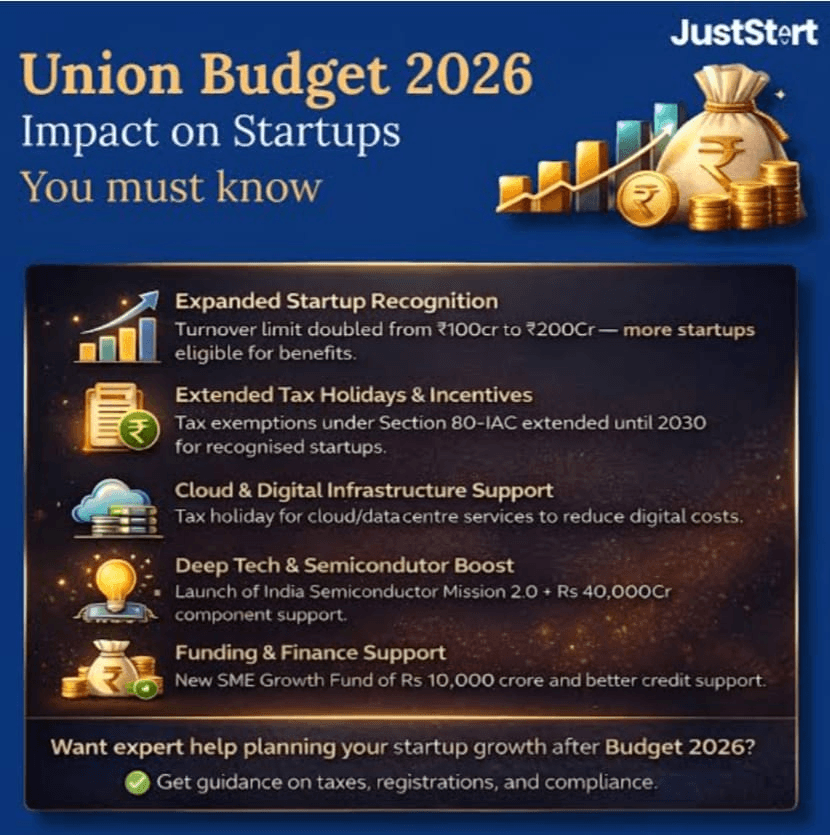
Extension of Section 80-IAC Tax Holiday
Startups incorporated until March 31, 2030 can claim 100% tax deduction for three consecutive years.
The turnover eligibility limit has increased to ₹150 crore, allowing scaling startups to benefit longer.
Check eligibility through Lawizer.
New Income Tax Act (Effective April 1, 2026)
- Share Buybacks: Now taxed as capital gains, improving employee and investor returns.
- MAT Reduction: Lowered to 14%, allowing better reinvestment capacity.
Safe Harbour for SaaS and ITeS
A new Global SaaS Safe Harbour reduces transfer pricing disputes.
- Threshold: Increased to ₹2,000 crore.
- Benefit: Fixed 15.5% margin reduces litigation and encourages reverse flipping.
This reform addresses long-standing concerns with the Income Tax Department.
Growth of the Orange Economy (AVGC)
The government has recognized the AVGC sector (Animation, VFX, Gaming, Comics) as a major growth engine.
Plans include setting up creator labs in 15,000 schools to build a future-ready workforce.
This creates opportunities for startups in EdTech, MediaTech, and Gaming via institutions like Indian Institute of Creative Technologies.
DeepTech and Semiconductor Push
The India Semiconductor Mission (ISM) 2.0 has been allocated ₹40,000 crore.
- Data Centers: Tax holiday until 2047 for global cloud providers.
- R&D Incentives: Reduced tax friction for research-driven startups.
E-commerce Export Boost (D2C)
The removal of the ₹10 lakh export cap simplifies global shipping for startups.
D2C brands can now scale exports seamlessly via logistics partners.
The ONDC network will enable global storefront access for Indian businesses.
Simplified Export Returns and Compliance
The government introduced a Digital Export Feedback Loop through the DGFT portal.
This allows duty-free re-import of returned goods, protecting margins for exporters.
Focus on AI Skills and Employability
The budget shifts focus from job creation to skill development.
A new committee aims to bridge gaps between education and employment in AI-driven industries.
Support is enhanced through the Anusandhan National Research Foundation (ANRF).
Ease of Doing Business Improvements
The government has decriminalized minor compliance defaults to promote a trust-based system.
- Tax Disputes: Pre-deposit reduced from 20% to 10%.
- TReDS Mandate: Faster payments for startups via receivable discounting systems.
Conclusion: Building for 2047
The Union Budget 2026 integrates startups into India’s long-term economic infrastructure.
Build for the world, solve for India, and growth will follow.
By aligning with Viksit Bharat 2047, founders can unlock significant opportunities.
Frequently Asked Questions
What is the new Safe Harbour threshold for SaaS startups?
A: The threshold has been increased to ₹2,000 crore, allowing companies to opt for a fixed 15.5% margin and avoid transfer pricing disputes.
How does the cloud tax holiday work?
A: Foreign cloud providers using Indian data centers get a tax holiday until 2047, with domestic compliance requirements.
What are the benefits for D2C startups?
A: Removal of export caps and simplified logistics enable easier global expansion via DGFT.
What is the Orange Economy?
A: It refers to AVGC sectors like animation, gaming, and media, now supported by government initiatives.
How is the AI talent gap addressed?
A: Through education reforms and a dedicated committee aligning curriculum with AI and deep-tech needs.
Is there support for startup liquidity?
A: Yes, TReDS ensures faster payments to startups, improving cash flow cycles.