
Your Tenant Won’t Leave. Now What? | Lawizer Blog
Free legal consultation for new clients · Book yours at lawizer.com →Lawizer Free Consultation Property Law · India Your Tenant Won’t Leave.Now What? A no-jargon guide for Indian landlords dealing with non-paying or non-vacating tenants — and how to resolve it legally, quickly, and without a single court visit. By Lawizer Legal Team|8 min read|PropertyTenant […]
Free legal consultation for new clients · Book yours at lawizer.com →Lawizer
Property Law · India
Your Tenant Won’t Leave.
Now What?
A no-jargon guide for Indian landlords dealing with non-paying or non-vacating tenants — and how to resolve it legally, quickly, and without a single court visit.
By Lawizer Legal Team|8 min read|PropertyTenant Disputes
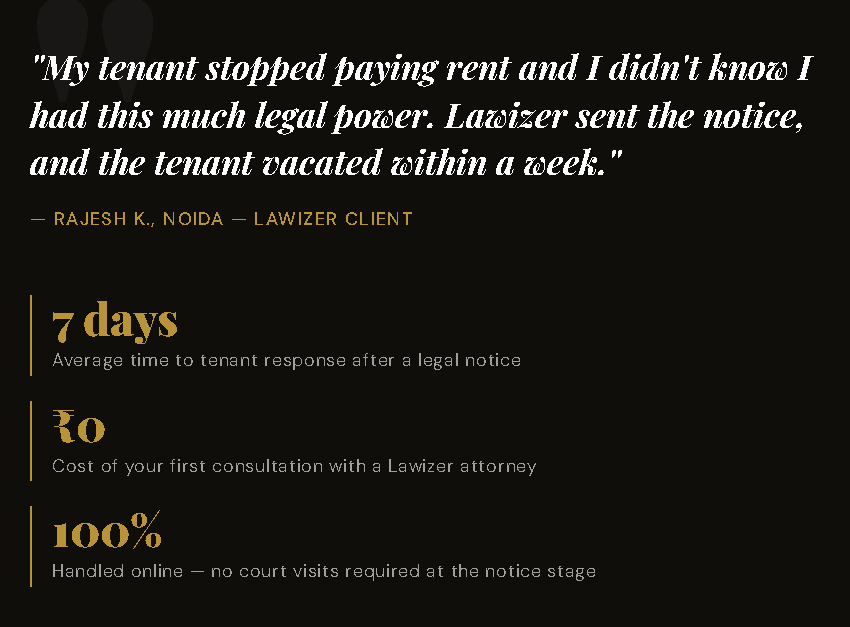
“My tenant stopped paying rent and I didn’t know I had this much legal power. Lawizer sent the notice, and the tenant vacated within a week.”
— Rajesh K., Noida — Lawizer Client
7 days
Average time to tenant response after a legal notice
₹0
Cost of your first consultation with a Lawizer attorney
100%
Handled online — no court visits required at the notice stage
The Situation No Landlord Expects:
You trusted someone with your property. You signed a rent agreement. And now — they’ve stopped paying, stopped responding, or flatly refused to leave when the agreement expired. You’re owed money. Your property is stuck. And every time you think about going to court, you imagine years of hearings, lawyer fees, and exhausting paperwork.
Here’s what most landlords in India don’t realize: you have far more power than you think, and most tenant disputes are resolved long before they reach a courtroom.
This guide walks you through exactly what to do — step by step — from the moment you realize there’s a problem.
“A well-drafted legal notice resolves more tenant disputes than all the court orders combined.”
First, Know Where You Stand Legally:
India doesn’t have a single national tenancy law. Depending on your state, your rights as a landlord are governed by one of these frameworks:
Applicable Laws by State Type
- States with Rent Control Acts (Delhi, Maharashtra, West Bengal, Tamil Nadu) — stronger tenant protections, specific eviction grounds required
- States with new Model Tenancy Act alignment — more balanced landlord-tenant framework
- Agreements registered under Transfer of Property Act, 1882 — contracts with teeth regardless of state-level rent control
The most important document you have is your registered rent agreement. If it’s properly registered and clearly states the tenancy period, rent amount, and vacating clause — you’re in a strong position. If your agreement is unregistered or expired, don’t panic. You still have options, but timing matters.
Your 5-Step Action Plan:
01
Document Everything Right Now
Collect all rent receipts, bank transfer records, WhatsApp messages, and the signed agreement. Screenshot every message where you requested payment or vacation. This paper trail becomes your case.
02
Send a Formal Legal Notice
This is the single most effective step. A legal notice sent by a lawyer via registered post carries serious weight. It signals you’re serious, creates a legal record, and gives the tenant a deadline to respond. Many disputes end here.
03
Negotiate a Settlement
If the tenant responds, there’s often room to negotiate a departure timeline or partial payment. A structured exit — even if imperfect — is faster than litigation. Have a lawyer supervise any written agreement.
04
File an Eviction Case if Required
Under the Transfer of Property Act Sec. 106 and your state’s Rent Control Act, you can file for eviction citing non-payment, misuse of property, or expiry of tenancy. Summary proceedings under CPC Order 37 allow faster recovery of dues.
05
Recover Unpaid Rent
Rent recovery is a civil suit. Once you have a decree, the tenant’s movable assets or bank accounts can be attached. Combined with the eviction proceeding, most lawyers structure this as a single coordinated filing.
Why the Legal Notice Is Your Most Powerful Tool
Landlords underestimate the psychological and legal power of a formal notice. Here’s what it actually does:
It creates a legal record. The moment your lawyer sends a registered notice, the clock starts. Any court proceeding later will note when you first formally demanded rent or vacation — this date matters for calculating dues and establishing bad faith on the tenant’s part.
It triggers the response deadline. Under the Transfer of Property Act Sec. 106, tenants on a monthly lease must receive 15 days’ notice for termination. A formal notice starts this clock precisely.
It moves the dispute out of the informal zone. Verbal requests, WhatsApp pleas, and in-person conversations carry no legal weight. A lawyer’s notice changes the entire dynamic — tenants who ignored you for months often respond within days.
Lawizer Can Help
Get a Legal Notice Drafted & Sent Today
Our property lawyers review your agreement, draft a watertight notice, and send it via registered post — completely online. No office visit required. Consult a Property Lawyer Free →
The 4 Mistakes Landlords Make (That Hurt Their Case)
1. Cutting off electricity or water
This feels satisfying. It is illegal. Courts treat it as coercion, and it can turn the landlord into the defendant. Do not do this under any circumstances.
2. Accepting rent after the agreement expires
If you accept even one month’s rent after the lease ends without a renewal, you may have legally created a periodic tenancy — and reset your eviction clock. Talk to a lawyer before accepting any post-agreement payments.
3. Entering the property without notice
Even as the owner, entering the tenant’s premises without advance notice (typically 24 hours) can constitute trespass. Document any entry attempts in writing.
4. Waiting too long to act
Every month of unpaid rent is a month of recoverable dues — but courts also look at whether you acted promptly. A six-month delay weakens your position. If the tenant hasn’t paid, issue a notice within 30 days of the first missed payment.
Common Questions Landlords Ask Us:
My rent agreement isn’t registered. Do I still have rights?
Yes. An unregistered agreement is still evidence of the tenancy arrangement. However, it cannot be produced in court as primary evidence in the same way a registered document can. That said, bank records and messages corroborating rent payment can supplement the claim. Consult a lawyer to assess your specific situation.
Can I ask the police to remove a tenant?
In most cases, no. Tenancy disputes are civil matters. Police will not forcibly remove a tenant without a court order. However, if the tenant has physically threatened you or caused damage to property, an FIR and relevant IPC provisions may apply.
How long does an eviction case actually take?
It varies by state and court load. In Rent Control Tribunals (common in metro cities), cases can stretch from 6 months to several years. However, most disputes that begin with a proper legal notice are settled before a final order — which is exactly why that first step is so critical.
What if the tenant just refuses to open the door?
Once you have a court order for eviction, a court commissioner — accompanied by the local police — can enforce it. But you need the order first. The process is: notice → no compliance → court filing → order → enforcement.
The landlord who documents everything and acts quickly wins. The one who waits six months hoping things resolve themselves — rarely does.
The Bottom Line:
A difficult tenant is stressful. But it’s a legal problem with a legal solution — and you don’t have to figure it out alone.
Start with a free consultation. Have a lawyer look at your agreement and your situation. In most cases, a single strong legal notice is all it takes.
Lawizer’s property lawyers have handled hundreds of landlord-tenant disputes across India — completely online, at transparent fees, with no surprise charges.
If your tenant has stopped paying or won’t leave, the best time to act was last month. The second best time is today.
In This Article
- 01 The situation no landlord expects
- 02 Know where you stand legally
- 03 Your 5-step action plan
- 04 The power of a legal notice
- 05 4 mistakes to avoid
- 06 Common questions answered
- 07 The bottom line
Facing a tenant dispute right now?
Talk to a Lawizer property lawyer free. We’ll tell you exactly where you stand in 30 minutes.Book Free Consultation
Related Property Services
- Property Paper Review
- Agreement Review
- Rent Agreement Drafting
- Sale Deed Drafting
- Property Registration
More from the Lawizer Blog
Startup Law Registering Your Company in India: The 7 Things No One Tells You Banking Cheque Bounce Under Section 138: Your Complete Legal Guide Tax ITR Filing Deadline 2025: Penalties, Extensions, and What to Do If You Missed It © 2026 Lawizer. All rights reserved. · Privacy Policy · Terms of Service · +91 90628 15535