
MSME Udyam Registration: Benefits, Eligibility & How to Register Free?
Over 7.30 crore enterprises have registered on the Udyam platform since July 2020 — and the ones that haven’t are leaving collateral-free loans, government tenders, and tax benefits on the table. MSME Udyam Registration is free, paperless, and takes under 30 minutes. Yet thousands of small business owners in Mumbai, Kolkata, Bengaluru, and beyond still […]
Over 7.30 crore enterprises have registered on the Udyam platform since July 2020 — and the ones that haven’t are leaving collateral-free loans, government tenders, and tax benefits on the table. MSME Udyam Registration is free, paperless, and takes under 30 minutes. Yet thousands of small business owners in Mumbai, Kolkata, Bengaluru, and beyond still skip it, either because they think they don’t qualify or assume the process is complicated.
It isn’t. Here’s everything you need to know.
What You’ll Learn
- Who qualifies for Udyam Registration under the revised 2025 limits
- The full list of financial and legal benefits for registered MSMEs
- A step-by-step walkthrough of the registration process on the official portal
- What documents you need and common mistakes to avoid
What Is MSME Udyam Registration and Why Does It Exist?
Udyam Registration is the official government process — managed by the Ministry of Micro, Small and Medium Enterprises (MSME) — through which a business gets formally recognised as a Micro, Small, or Medium Enterprise under the MSMED Act, 2006 (the Micro, Small and Medium Enterprises Development Act).
It replaced the older Udyog Aadhaar system in July 2020, and the upgrade was significant: the new system integrates your Aadhaar and PAN directly with government databases, meaning no document uploads, no physical visits, and no fees.
Here’s the thing: MSME status isn’t just a label. It is a legal identity that unlocks a specific set of rights — from priority bank lending to protection against buyers delaying payments beyond 45 days. Without it, you’re running your business with one hand tied behind your back.
Whether you’re a manufacturer in Pune, a service provider in Chennai, or a trader in Delhi, if your business falls within the defined limits, you qualify. And since July 2021, even retailers and wholesalers are eligible.
Revised MSME Classification Limits: Are You Eligible?
The Union Budget 2025 made the single biggest revision to MSME definitions since the system launched. Effective 1 April 2025, investment limits were increased by 2.5 times and turnover limits were doubled. This means lakhs of businesses that previously didn’t qualify now do — and existing registrations were upgraded automatically without any re-registration.
Here’s how the three categories break down under the revised classification (both conditions — investment AND turnover — must be satisfied):
Micro Enterprise: Investment up to ₹2.5 crore AND annual turnover up to ₹10 crore
Small Enterprise: Investment up to ₹25 crore AND annual turnover up to ₹100 crore
Medium Enterprise: Investment up to ₹125 crore AND annual turnover up to ₹500 crore
What most founders miss: the classification uses composite criteria. If your turnover crosses the ceiling for your category — even if your investment hasn’t — you automatically move up. All units operating under a single PAN are aggregated when calculating these thresholds, so if you run multiple businesses, plan accordingly.
A quick example: a Bengaluru-based SaaS firm with ₹8 crore invested in servers and ₹40 crore annual turnover qualifies as a Small Enterprise — eligible for the full suite of MSME benefits, including the enhanced credit guarantees introduced in Budget 2025-26.
All business types are eligible: proprietorships, partnership firms, LLPs, private limited companies, public limited companies, HUFs, co-operative societies, trusts, and producer companies. Manufacturing, services, trading — all covered. The only entities that don’t qualify are those that exceed the Medium Enterprise ceilings (investment above ₹125 crore or turnover above ₹500 crore) and non-business entities like NGOs or government departments.

Key Benefits of MSME Udyam Registration in 2025–26:
This is where registration pays for itself many times over. Let’s break this down by category.
Financial and Credit Benefits
The biggest draw for most businesses is access to institutional credit they’d otherwise struggle to get. Udyam-registered MSMEs are eligible for the Credit Guarantee Fund Trust for Micro and Small Enterprises (CGTMSE) — the government’s flagship scheme that allows banks to extend collateral-free loans up to ₹5 crore for micro and small enterprises, with the credit guarantee cover for micro enterprises doubled to ₹10 crore in Budget 2025.
Loans under the MUDRA scheme (Micro Units Development and Refinance Agency) are also accessible, and banks are mandated to offer concessional interest rates to registered MSMEs. The new ME-Card — a customised credit card with a ₹5 lakh limit for Udyam-registered Micro Enterprises — was introduced in Budget 2025, with 10 lakh cards planned in the first year.
Government Procurement Advantages
Under the Public Procurement Policy, 25% of all Central Government procurement must come from MSMEs, with an additional 4% reserved for SC/ST-owned enterprises and 3% for women-owned enterprises. On GeM (Government e-Marketplace), Udyam-registered businesses get preferential access, exemption from Earnest Money Deposits (EMD), and are shortlisted for MSE-specific tenders with relaxed eligibility criteria.
For any business wanting to supply to government departments, PSUs, railways, or defence establishments, Udyam registration is the baseline requirement.
IP and Certification Subsidies
This one surprises most founders. Registered MSMEs are eligible for up to 80% subsidy on patent filing fees and significant reimbursements on trademark registration and ISO certification costs. If you’re building a brand or a product and haven’t registered as an MSME, you’re paying full price for protections the government wants to help you afford. You can explore trademark registration for your startup through Lawizer’s MSME registration services.
Protection Against Delayed Payments — Section 43B(h)
The MSMED Act gives registered MSMEs a legal shield that unregistered businesses simply don’t have. Buyers are legally required to pay registered Micro and Small Enterprises within 45 days of delivery (or within the agreed credit period, whichever is shorter). If they don’t, the overdue amount attracts compound interest at three times the RBI’s bank rate.
Under Section 43B(h) of the Income Tax Act (as amended), buyers cannot claim a tax deduction on payments to MSMEs made beyond 45 days — giving you real negotiating power. This protection is only available to registered businesses.
Tax and Compliance Benefits
Registered MSMEs get extended carry-forward of Minimum Alternate Tax (MAT) credit — up to 15 years instead of the standard 10. Several state governments offer additional incentives: electricity tariff subsidies, stamp duty exemptions on property transactions, and interest subvention schemes. These vary by state, so it’s worth checking with your state’s Directorate of Industries.
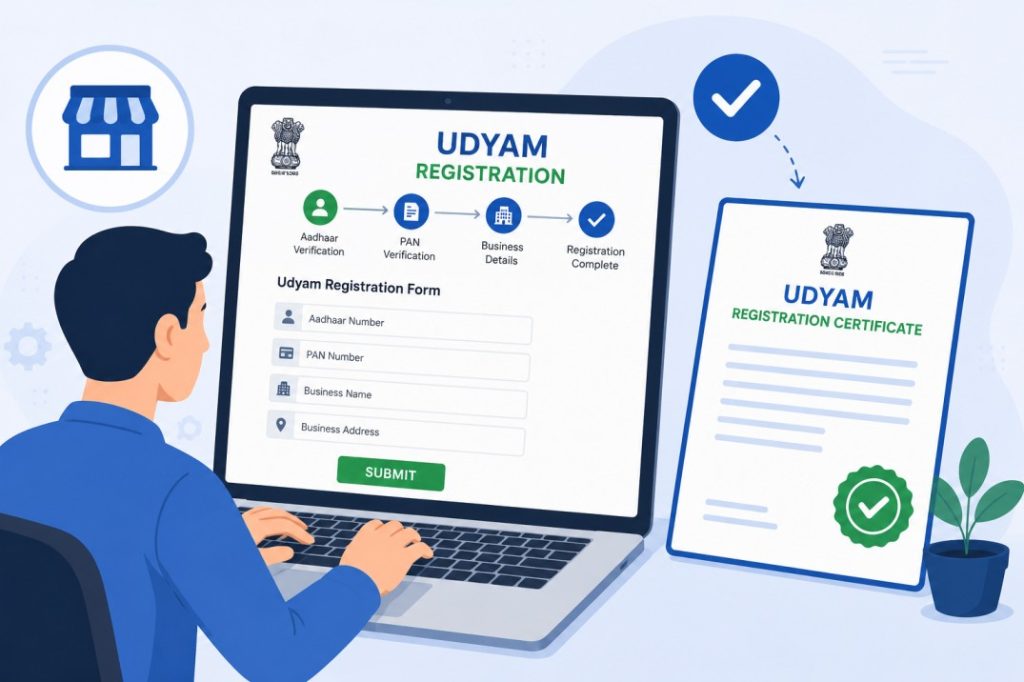
How to Register for Udyam Online — Step by Step
The registration process is entirely self-declaration based. You don’t upload any documents. The portal pulls your investment and turnover data directly from your Income Tax and GST filings. Here’s the complete process:
Step 1 — Visit the Official Portal
Go to udyamregistration.gov.in — the only government-authorised portal for Udyam Registration. Be careful: dozens of private websites charge fees for this process. The official portal is free.
Step 2 — Choose the Right Application Type
If you’re a new enterprise with no prior registration: select “For New Entrepreneurs who are not Registered yet as MSME or those with EM-II.”
If you had a prior Udyog Aadhaar or EM-II registration: select the migration option to convert it.
Step 3 — Enter Your Aadhaar Details
The applicant’s Aadhaar number and name (as on the Aadhaar card) are required. For proprietorships, use the owner’s Aadhaar. For companies, partnerships, or LLPs, use the authorised signatory’s Aadhaar. OTP verification via registered mobile completes this step.
Step 4 — Fill in PAN and Business Details
Enter your PAN, business name, type of organisation, date of commencement, bank account details, and your main business activity (manufacturing or services). Select the appropriate NIC (National Industry Classification) 2008 code that matches your core business.
Step 5 — Submit Investment and Turnover Details
Enter investment in plant and machinery (or equipment) and annual turnover. The portal cross-verifies this against your ITR and GST filings automatically. No proof needs to be uploaded.
Step 6 — Submit and Receive Your Udyam Registration Certificate
After submission, you receive a unique 12-digit Udyam Registration Number (URN) and a digital e-certificate with a QR code. This certificate has lifetime validity — no renewal required. You can also store it in DigiLocker, and it’s legally recognised under the IT Act, 2000.
What most founders miss: your Udyam classification is auto-recalculated every financial year based on the ITR and GST data you file. If your turnover grows and you cross a category ceiling, reclassification happens automatically. You don’t need to re-register, but you should check your Udyam portal status annually.
Common Mistakes to Avoid
- Let’s be direct about what goes wrong most often.
- Registering on a private paid portal instead of udyamregistration.gov.in — the government portal is free, and there is no official fee whatsoever.
- Entering NIC codes incorrectly — mismatched activity codes can cause verification issues when applying for tenders or schemes that require specific sector codes.
- Mixing up Udyam with Udyog Aadhaar — if you have an old Udyog Aadhaar registration (valid till March 2021), it must be migrated to Udyam to continue accessing benefits. Unmigrated registrations are now considered inactive.
- Not updating annually — failure to update your turnover and investment details on the Udyam portal can result in your status being marked inactive, cutting off access to schemes.
- If you want a professional to handle the application and verify all details are accurate, Lawizer’s team can assist with your MSME Udyam Registration fully online — no CA visit required.
Frequently Asked Questions
Q: Is Udyam Registration really free, or are there hidden charges?
A: Udyam Registration is completely free on the official government portal at udyamregistration.gov.in. There are no government fees, no charges for the certificate, and no renewal costs. The certificate has lifetime validity. If any website is asking you to pay for Udyam Registration, it is a private consultancy, not the government. You are not required to use any paid service for this process.
Q: What documents do I need to register on the Udyam portal?
A: You don’t upload any documents. The Udyam Registration process is entirely self-declaration based, and the portal cross-verifies your data directly against your Aadhaar, PAN, ITR, and GST records. You will need your Aadhaar number (with OTP access on the linked mobile), PAN card, business bank account details, and your approximate investment in plant and machinery or equipment. That’s it.
Q: I already had Udyog Aadhaar. Do I need to re-register on Udyam?
A: Yes, you need to migrate. Udyog Aadhaar registrations became invalid after March 31, 2021. To continue accessing MSME benefits — including loans, government tenders, and subsidies — you must migrate your registration to the Udyam portal. The migration option is available on udyamregistration.gov.in and the process is straightforward. Existing registrations that were migrated also automatically benefit from the revised 2025 limits without re-registration.
Q: Can a private limited company or LLP register as an MSME?
A: Yes. Any business entity — proprietorship, partnership firm, LLP, private limited company, public limited company, HUF, co-operative society, or trust — that falls within the investment and turnover limits can register under Udyam. For companies and LLPs, the authorised signatory’s Aadhaar is used for the application. All units of the same enterprise operating under a single PAN are treated as one entity when calculating the thresholds.
Q: What is Section 43B(h) and how does it protect registered MSMEs?
A: Section 43B(h) of the Income Tax Act (effective from April 1, 2024) disallows buyers from claiming a tax deduction on payments made to Micro and Small Enterprises beyond 45 days. This means that if your buyer delays payment, they lose their tax deduction — giving registered MSMEs significant legal and financial leverage over large buyers and corporates. This protection applies only to businesses registered under Udyam as Micro or Small Enterprises. Unregistered businesses have no such recourse.
Q: What happens if my business grows and crosses the MSME limits?
A: Your Udyam classification is automatically recalculated every financial year based on the ITR and GST returns you file. If your investment or turnover crosses the ceiling for your current category — say you cross ₹100 crore turnover as a Small Enterprise — you’re automatically reclassified as a Medium Enterprise. If you eventually cross the Medium ceiling (₹500 crore turnover or ₹125 crore investment), your MSME status lapses and you lose access to MSME-specific schemes going forward. You don’t need to manually update this; the portal handles it automatically.
Ready to Get Your Udyam Certificate?
Lawizer’s experts handle everything — MSME Udyam Registration, compliance filing, and GST registration — fully online, starting at just ₹499. No CA visit needed.